Donate $25 for two DVDs of the Cryptome collection of files from June 1996 to the present

Natsios Young Architects


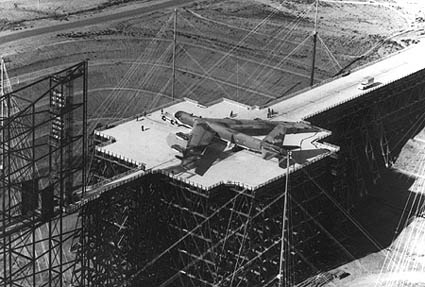
8 February 2004. Updated to added photo of B-52 on the Trestle.

24 January 2004 updated.

18 January 2004
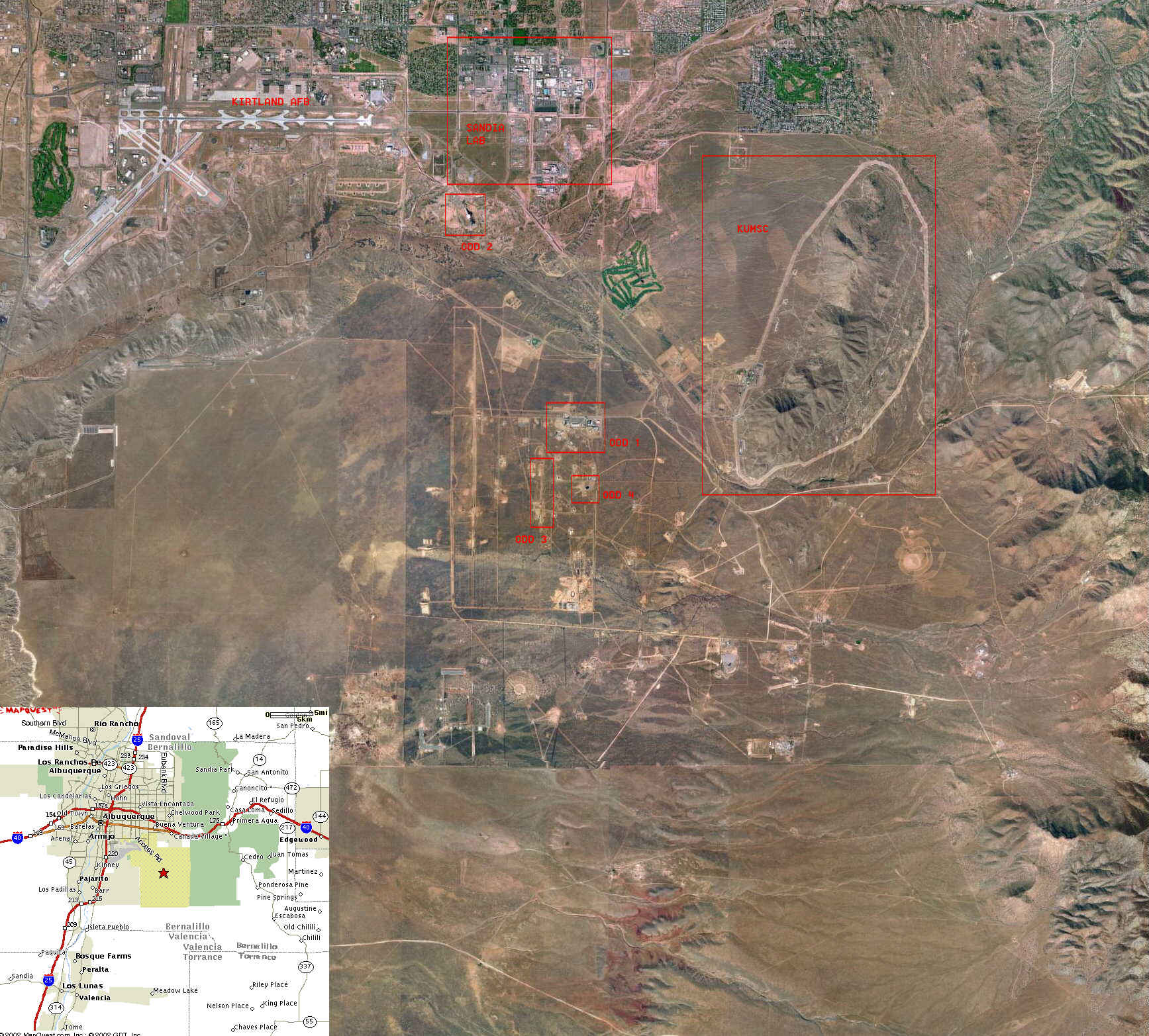
Maps from Mapquest.com
Source of satellite photos (dated March 2002): http://seamless.usgs.gov
Big-six photos were downloaded 18 January 2004.


These photos show six odd facilities located at Kirtland Air Force Base, Albuquerque, NM. Kirtland hosts Sandia National Laboratory, a premier nuclear and other research facility, the Defense Nuclear Weapons School and the Kirtland Underground Munitions Storage Center, a giant nuclear weapons storage area.

While the facilities may be associated with Sandia's diverse research program, they could be run by other agencies or private institutions engaged in classified or open work as contractors to the US government.


Big Eyeballing
the
Six Odd Facilities at Kirtland Air Force Base

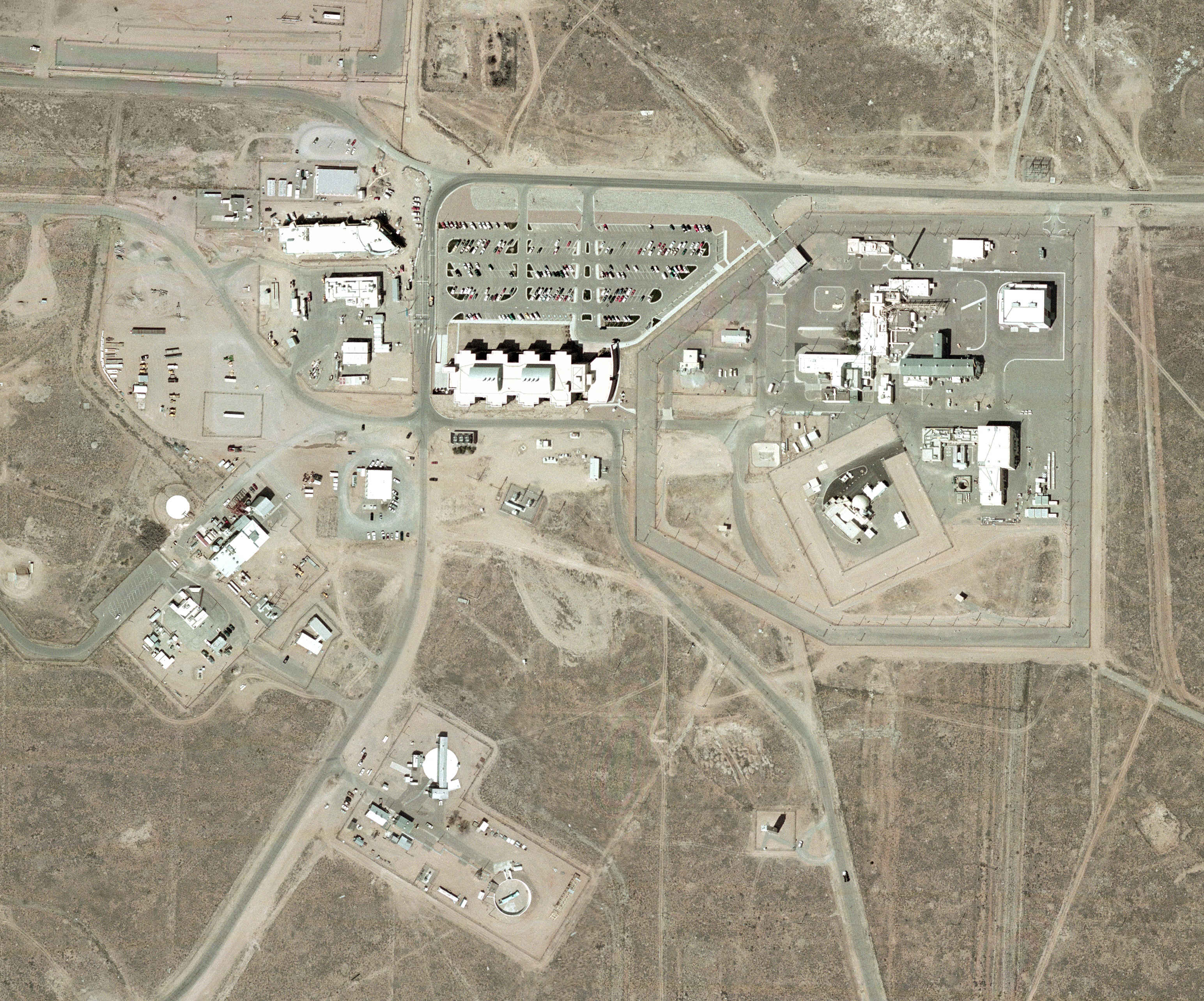
ODD FACILITY 1 -- THE SQUARE

A. writes:

Odd facility 1 is a 2-reactor facility; I spent a week there while I worked for the lab. The inner
facility is the SPUR, Sandia Pulse reactor. Plates of enriched uranium, basically, with a
negative temperature coefficient. It's used to irradiate military stuff (or used to be, I have no
idea when it was last used) as a simulation of an atomic explosion. According to the people
who had been there a while, when SPUR fired you could be in the parking lot on the left with
your eyes closed, and the blue flashes you'd see were fast neutrons zipping through your
eyeballs. Nice, eh?

Anyway, SPUR uses 'weapons grade' material, thus the safeguards. None of this was classified
when I was there, by the way.

The other area inside the main fence is ACRR, (Annular core research reactor), a 2MW toy
reactor used for various tests. We used it to play with diffractive optics; fun project. There's
also GIF, the gamma irradiation facility, inside the same building.

Amusingly, the office building on the left was a minor scandal at the time; major cost overruns.

______

A. further writes:

A news item on SPUR:

http://nucnews.net/nucnews/2000nn/0010nn/001019nn.htm#14

Looks like they buried it after I left, which makes sense to me.

A search of sandia.gov finds lots of links on GIF and the ACRR:

http://www.sandia.gov/EE/nt.html

http://www.sandia.gov/LabNews/LN02-07-03/labnews02-07-03.pdf

______

What is distinctive about this facility is that it is the only one other than Pantex Cryptome
has seen that has a high-security-fenced area within a high-security-fenced area, one fence
around a principal facility at the right and another fence around a smaller facility within.

These high-security fences are most often found at highest-level national security facilities
such as presidential aircraft hangars and nuclear weapons storage areas, but none of these
have two double-fences such as those shown here.

USGS Coordinates of Photograph
Southwest (Bottom Left) Corner Northeast (Top Right) Corner
34.994171 N, 106.542490 W 35.000986 N, 106.532470 W

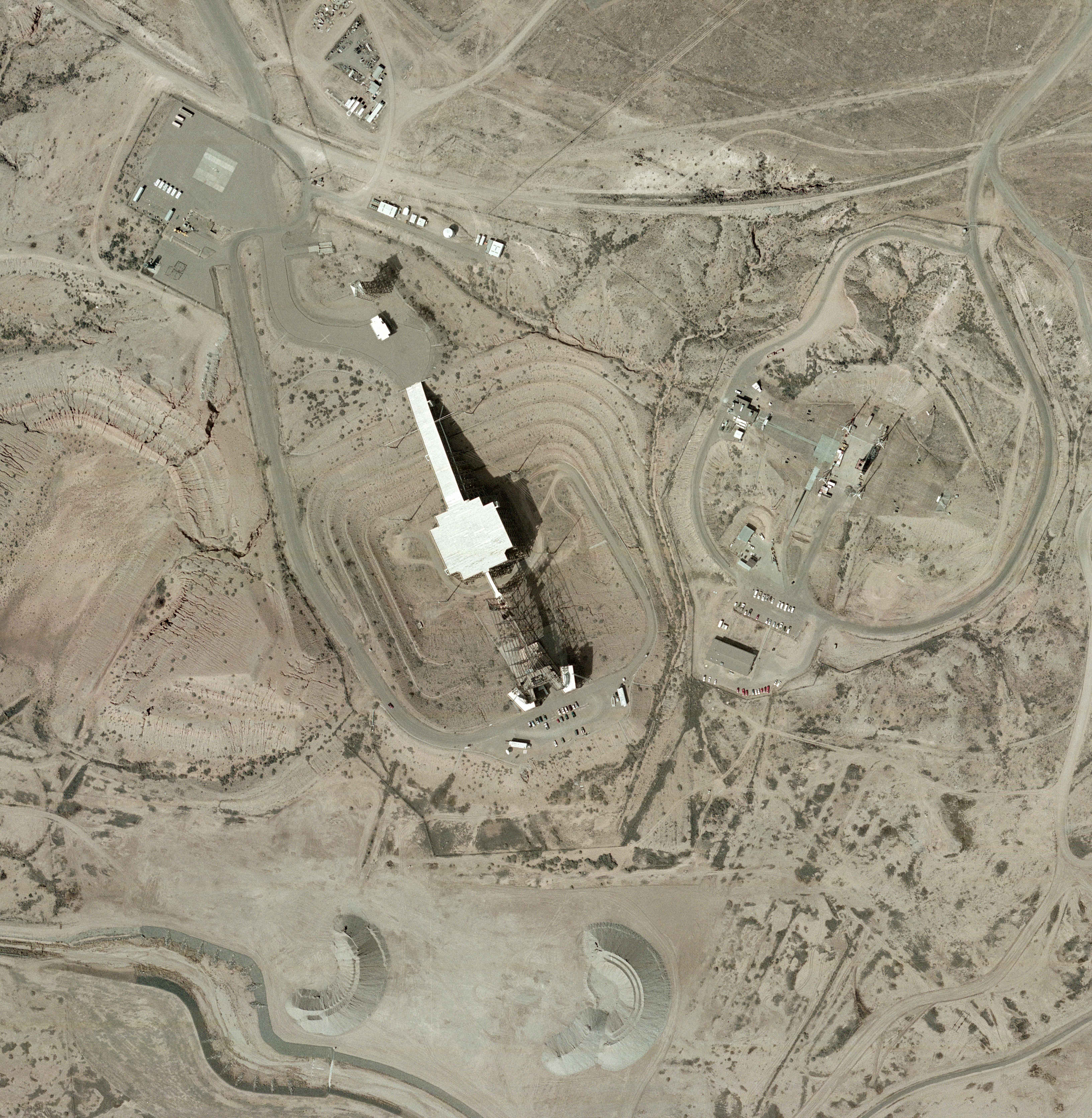
ODD FACILITY 2 -- THE TRESTLE

A. provides:

Atomic Audit: The Costs and Consequences of U.S. Nuclear Weapons Since 1940

The Trestle Electromagnetic Pulse Simulator


A B-52 bomber sits atop the TRESTLE electromagnetic
pulse (EMP)  simulator at Kirtland Air Force Base, New Mexico

The facility is the largest wood-and-glue laminated structure in the world. Aircraft tested
here are subjected to up to 10 million volts of electricity to simulate the effects of a nuclear
explosion and assess the "hardness" of electrical and electronic equipment to the EMP
pulse generated by a nuclear burst.

Credit: U.S. Air Force (courtesy Natural Resource Defense Council)

__________

R. writes:

The wooden trestle is the world's largest all-wood structure.

__________

J. writes:

Facility 2 at Kirtland is the "Trestle," a huge wooden structure used to support large aircraft
while they were subjected to electromagnetic pulse simulations.

__________

D. writes:

Something else to note about the trestle at Kirtland is that it is built entirely without metal
fasteners (nails, bolts, etc).  It's all wooden peg construction.   This is to reduce the
bounce effect of EMP on the aircraft from the large volume of metal that the connectors
would be.

USGS Coordinates of Photograph
Southwest (Bottom Left) Corner Northeast (Top Right) Corner
35.025281 N, 106.562284 W 35.034181 N, 106.551721 W

ODD FACILITY 3 -- THE SLED

A. further provides:

Note that http://mfnl.xjtu.edu.cn/gov-doe-sandia/afsec/afsec.htm has links to the rocket
sled track and other Sandia things in the vicinity.

__________

A. provides:

ABQjournal: Sandia's Rocket Sled Delivers High-Speed Crash Test

Albuquerque Journal

Friday, April 18, 2003

Sandia's Rocket Sled Delivers High-Speed Crash Test

By John Fleck

Journal Staff Writer

From rocket ignition to crash, the whole thing was over in about the time it took you
to read this sentence. The sled blasted down the track so fast that it slammed into its
target before the sound -- the roar of a rocket and a sonic boom -- reached observers
watching from a tower 920 feet from the track.

In a world where torture testing is the norm, the 10,000-foot sled track might be the
ultimate.

The men and women at Sandia National Laboratories' Area 3 specialize in slamming,
spinning, shaking, dropping and burning things, adding exquisite meaning to the words
"worst-case scenario." Their goal is to help ensure that all manner of technology, from
military equipment to nuclear reactor containment vessels, will work under some pretty
demanding conditions.

Want to build a nuclear waste container tough enough to survive a fuel fire? How about
a concrete wall able to take a hit from a fighter jet? U.S. nuclear weapon parts are spun
on centrifuges here to make sure they can withstand the G forces of a rocket launch.

But for the connoisseur of destructive testing, nothing beats the rocket sled.

Some U.S. nuclear weapons have to hit the ground and still be able to detonate. The
men and women at Area 3 just need to know how fast it will hit, and they can create a
test for a mock nuclear weapon that simulates the real-world environment it might face.

The phrase "rocket sled" has become a cliché to describe something exceptionally fast,
and the real thing lived up to its billing in a recent test.

Duane Patrick hovered over the 6-foot, 91/2-inch sled, carefully adding reflective tape.
Patrick and his colleagues built the sled to test a laser tracking system developed at Sandia.

Historically, experienced camera operators with high-speed film cameras would stand on
an observation tower, following the action by hand. That relatively low-tech approach is
still used. For this particular test, two cameramen were on the observation tower filming.
But the truck-sized laser tracking system provides more precise data.

Bouncing a laser off the reflective tape or mirrors mounted on the rocket, the tracker controls
cameras that follow the sled down the track. It also can provide precise data on the speed
and position of the sled.

Once Patrick had the tape affixed to the rocket, he and the other members of the crew cleared
out, heading for their various observation posts, and a safety crew double-checked to make
sure the test area was clear.

The 10,000-foot track Patrick was using for his test and an older 2,000-foot track cross open
desert land near the southern edge of Kirtland Air Force Base, southeast of the Albuquerque
airport's runways. At one end, rocket sleds are mounted to the rails and fired on their way.
At the other, batteries of sophisticated cameras record the sometimes dramatic results as the
sled slams into its target. The action is measured in milliseconds. "Things happen really fast
in our world," said Tim Brown, one of the sled track's field test engineers. The end result is
usually a pile of rubble, but the cameras capture the action in excruciating detail, at rates of
up to 10,000 frames per second.

That allows the scientists to slow things down and figure out what happened, explained Jack
Reed, one of the camera experts. "To the human eye, it's just a blink," Reed said.

Sandia's most dramatic and famous sled track test was done in the spring of 1988. An F4
Phantom fighter jet was mounted on a sled and slammed into a concrete wall to simulate an
airplane crashing into a nuclear reactor containment vessel. The plane was obliterated. The
wall survived.

Sandia's first rocket sled track, the 2,000-foot one, was built in 1951. The section track was
built 5,000 feet long in 1966, then lengthened in 1985.

Patrick's laser tracker test was a relatively small one by sled track standards. The sled was
designed to run on just one of the track's two rails. All that awaited it at the end of the track
was a piece of thick steel and a pile of dirt.

On a radioed countdown from the test control center, three small explosives along the length
of the track were set off, noisemakers to scare away birds that like to sit on the rails.

"With a supersonic sled, the birds can't hear it coming," said Steve Heffelfinger, who manages
the test site.

The rocket was electronically fired, and with a flash and a cloud of smoke it shot down the
track, accelerating rapidly before disappearing into the dirt pile at the end of the track. An
analysis of the data afterward showed that it took just 3.47 seconds to make the 6,000-foot trip.
Its top speed, 2 seconds into the trip, was 2,700 feet per second, according to data reconstructed
by Patrick's laser tracker.

In his office afterward, Patrick showed the laser tracker videotape of the test, slowing it down
to look, frame by frame, at the way his system had performed. As the sled rocketed down the
track, shock waves could be seen blasting away through the air -- visual evidence of the sonic
boom.

The excitement over, the scientists turned to their real work -- analyzing the data they collected.
"This is the heart of our business," Heffelfinger explained, as he looked over Patrick's shoulder
at the video image. "People think it's the wham-bam stuff, but this is it."

Copyright 2003 Albuquerque Journal

__________

This tracked facility appears to have a sled or other tracked device on it.

USGS Coordinates of Photograph
Southwest (Bottom Left) Corner Northeast (Top Right) Corner
34.985931 N, 106.546438 W 34.992983 N, 106.539623 W

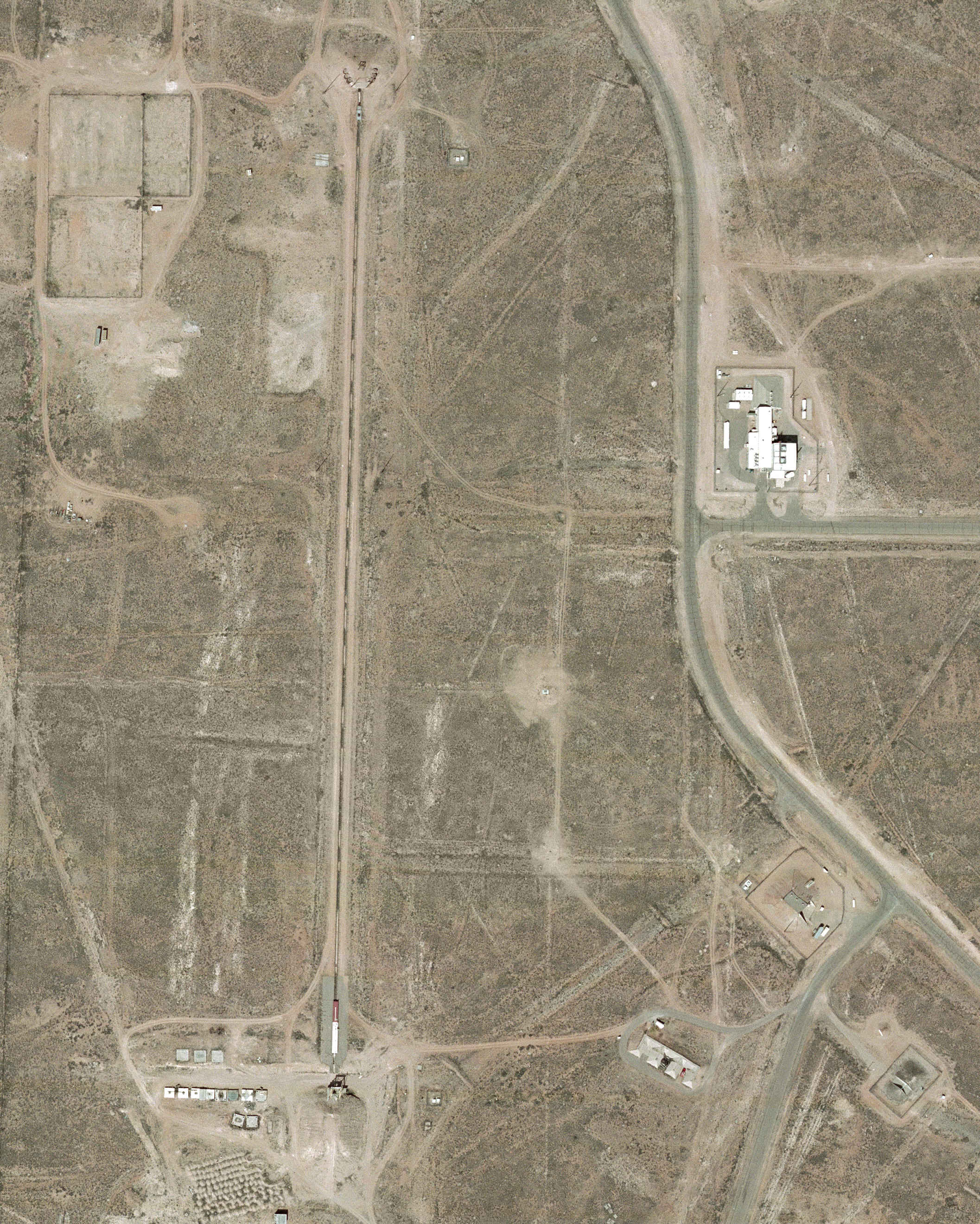
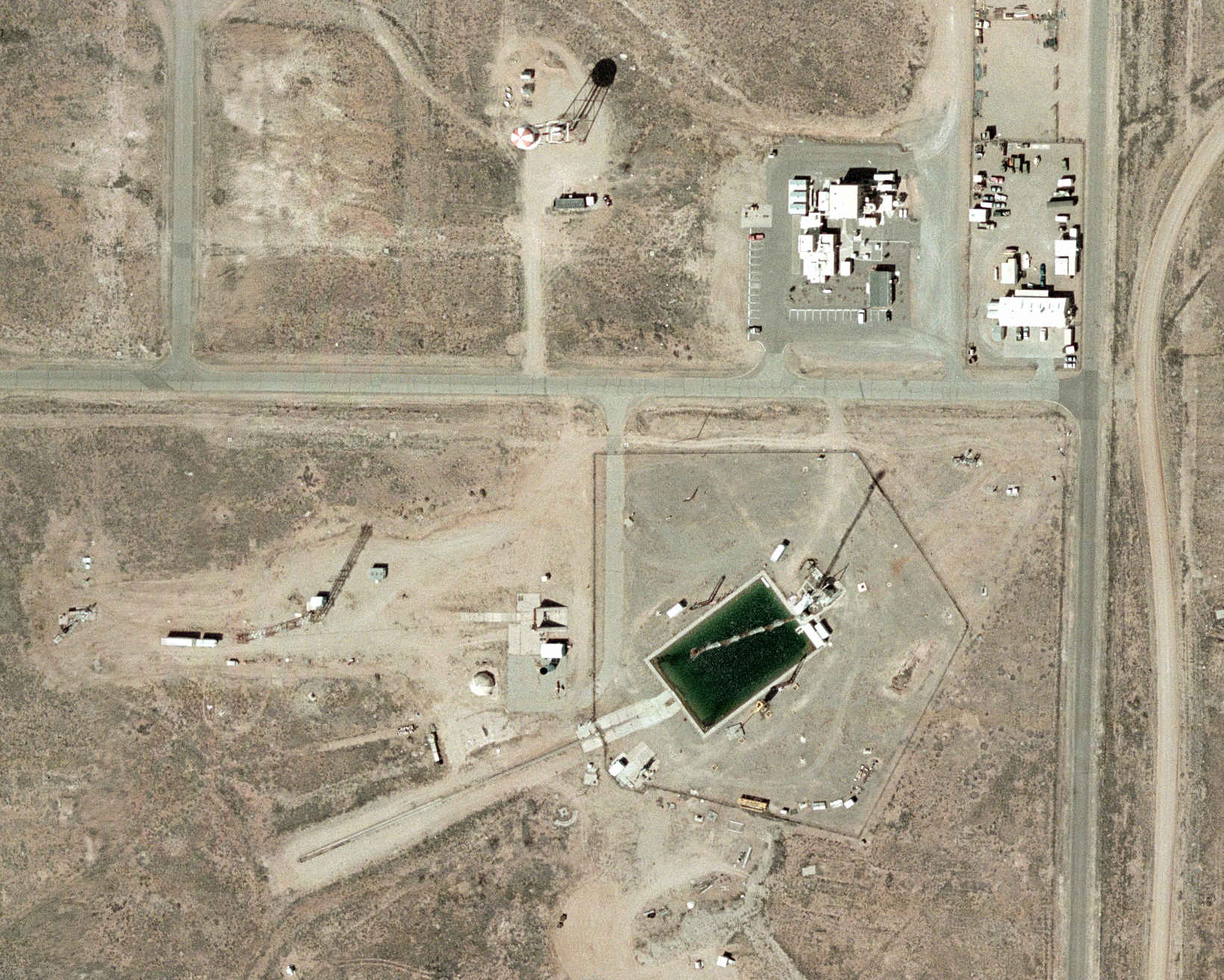
ODD FACILITY 4 -- THE POLE

A. writes:

The pool in Odd-4 appears to be the "water impact facility":

http://mfnl.xjtu.edu.cn/gov-doe-sandia/afsec/facility/water.htm

__________

R. writes:

I've been told by another friend who works for Sandia that the giant pool is for
splashdown tests, but you might want to get some further confirmation on that.

__________

This tall pole and pool with extended pipe or trench extending outside the fence, has a smaller pole
at left.

USGS Coordinates of Photograph
Southwest (Bottom Left) Corner Northeast (Top Right) Corner
34.987878 N, 106.539065 W 34.991357 N, 106.533746 W

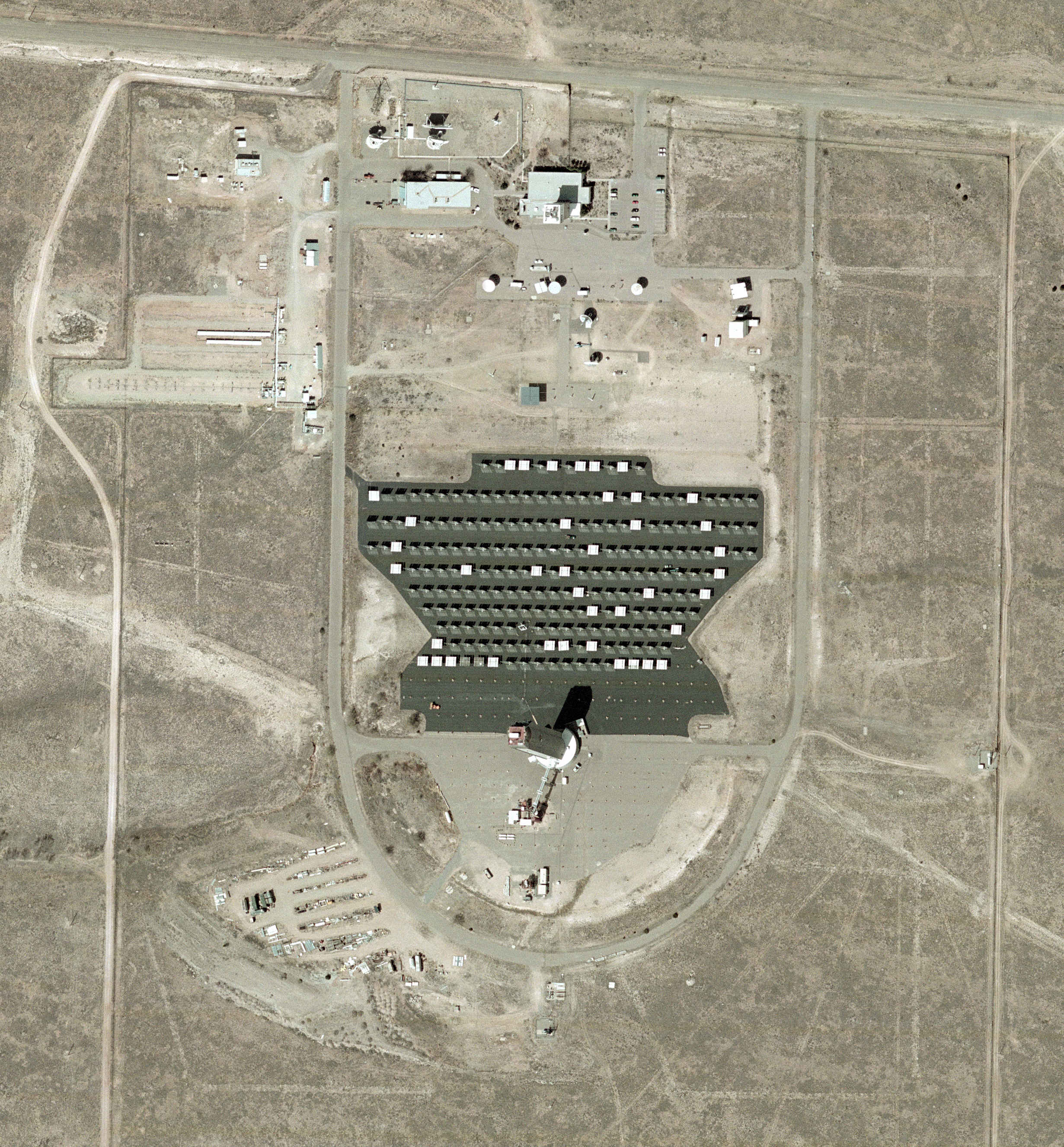
ODD FACILITY 5 -- THE STOVE

P. writes:

Info on "Odd Facility 5 - The Stove" can be found here:

http://www.eere.energy.gov/sunlab/

I visited the base back in 94 to check out a pretty good museum they have on-base on
atomic weaponry and saw that they also had a visitor area for this project. It's pretty
remarkable. If I remember correctly the mirrors (the small blackish square things)
track the sun an concentrate the light at the stack. At the time they were using liquid
lithium (heated by the focused solar rays) for high temperature experiments. Again,
this was 10 years ago and it didn't seem to be a closed or secret project at the time.

__________

A. provides:

http://www.sandia.gov/Renewable_Energy/solarthermal/NSTTF/index.htm

__________

R. writes:

My boss's husband works at #5. The things that look like radio telescopes focus sunlight to heat
sodium and power a sterling engine. The huge array of mirrors focus sunlight at the top of the
tower at the bottom for another means of mechanical solar power.

As a fun aside, while the tower is being used, birds often fly into the beam and burst into flames.

__________

This appears to be a solar facility, for photovoltaic research or mirror-focused and -enhanced
directed sunbeam. The numerous disk antennas are curious, and one of them, at the top center,
appears coupled with a reflector or flat square antenna.

USGS Coordinates of Photograph
Southwest (Bottom Left) Corner Northeast (Top Right) Corner
34.959825 N, 106.513794 W 34.966901 N, 106.505839 W

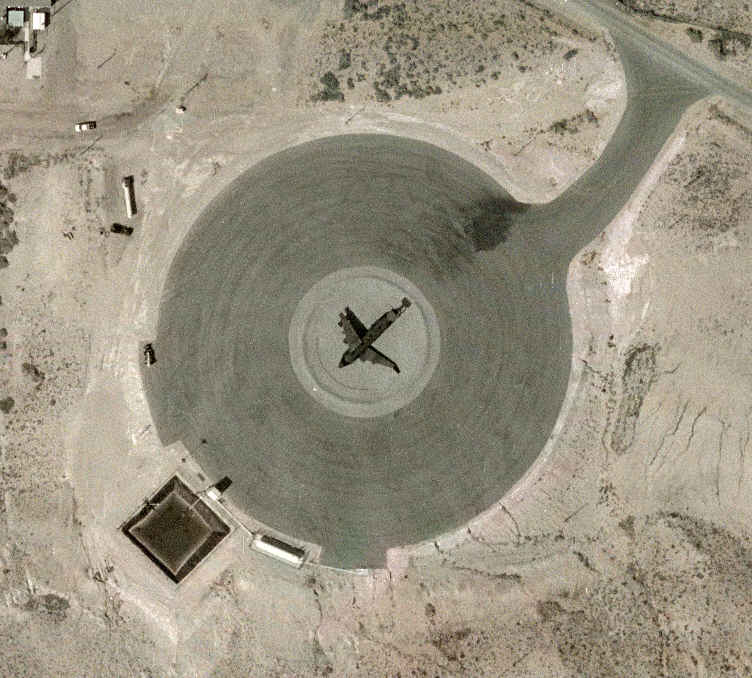
ODD FACILITY 6 -- THE BIRD

A. writes:

'Odd Facility 6' is an aircraft fire practice area.

__________

A bullseye spotting of what appears to be an aircraft or a mock-up, whose tail shadow is
weird. The adjoining square pool or pit adds odd.

USGS Coordinates of Photograph
Southwest (Bottom Left) Corner Northeast (Top Right) Corner
35.037940 N, 106.601697 W 35.039739 N, 106.599262 W